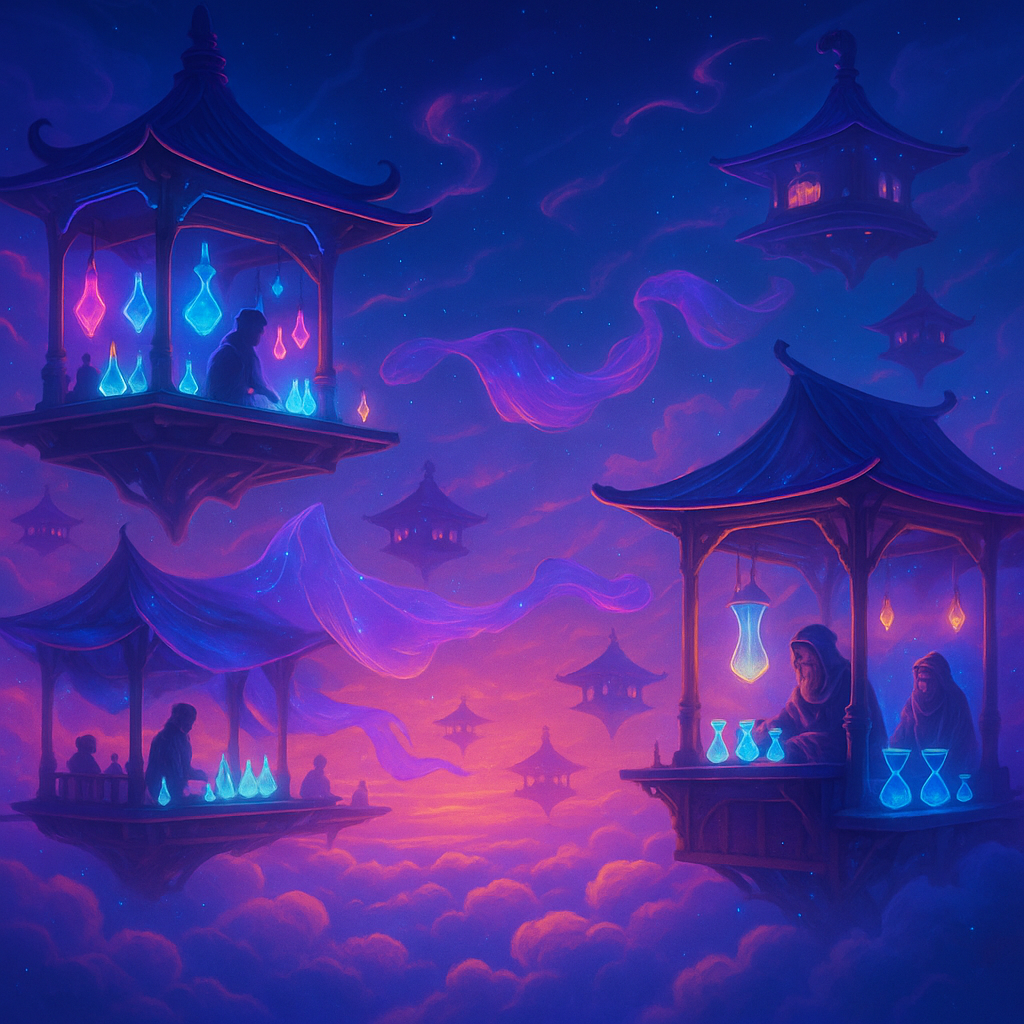
High above the dreaming spires and stardust highways of Noctura, where the dimensional fabric grows thin and the light takes on a quality that photographers in lesser worlds would sacrifice limbs for, there exists the most extraordinary marketplace in any known reality: the Floating Market of Noctura. It is not built on any surface, for there is no surface to build upon. It drifts — majestically, lazily, perpetually — through the highest reaches of the city's sky, a constellation of platforms, stalls, and impossible shops suspended on nothing but accumulated wonder.
The market appears differently to everyone who visits it. To a first-timer, it might seem like a cluster of luminous clouds with glowing doorways. To a regular, it reveals its true complexity — hundreds of floating platforms of varying sizes, connected by bridges of solidified light, arranged in a three-dimensional maze that rearranges itself based on the collective desire of its shoppers. If enough people are looking for nostalgic trinkets, the nostalgia vendors float to the market's center. If the mood shifts toward adventure, the exotic artifact dealers take prominence. The market reads its customers like a master storyteller reads an audience.
The vendors of the Floating Market were as diverse as their wares. Some were ancient Dreamwalkers who had been trading since Noctura's earliest days. Others were travelers from distant dimensions who had come to Noctura seeking something and ended up staying because there was nowhere else in the multiverse where their particular talents were so richly appreciated.
"Would you like to buy a Thursday afternoon from seventeen years ago? I have a lovely one — warm sun, slight breeze, the distant sound of someone you've forgotten calling your name."
The most sought-after goods in the market were the bottled memories. These were exactly what they sounded like — memories extracted from willing donors, distilled, and preserved in vessels of blown starlight. Each bottle glowed with its own inner light, the color determined by the nature of the memory within. Golden bottles contained moments of pure joy. Blue bottles held contemplative solitude. Pink bottles stored the breathless electricity of first love. And the rarest — bottles of pure white — contained moments of epiphany, those rare instants when someone truly understood something profound about the universe for the very first time.
Customers didn't simply purchase these memories; they experienced them. Uncorking a bottle released the memory like perfume, enveloping the buyer in a full sensory recreation of the moment. You could smell the air, feel the temperature, hear the ambient sounds. For the duration of the experience, you were the person whose memory it had been. Many citizens of Noctura collected memories the way people in other worlds collected art — curating personal galleries of extraordinary moments borrowed from extraordinary lives.
Equally remarkable was the trade in crystallized time. Master chronosmiths — artisans who had learned to manipulate the flow of time within Noctura's unique dimensional properties — could extract moments from the timestream and compress them into crystalline form. A crystal of time could be used in countless ways: dissolved in tea, it would slow the drinker's perception, making a single hour feel like a luxurious day. Worn as jewelry, it created a personal time bubble that allowed the wearer to exist at their own pace while the world rushed on around them. And when placed in a room, time crystals could age wine, cure materials, or simply provide a quiet place where the relentless march of moments didn't feel so rushed.
The fabric merchants occupied an entire district of the market — a cluster of platforms draped in impossible textiles that rippled and shifted even when the air was perfectly still. The fabrics of Noctura were alive in the truest sense. Dream-silk changed color based on the wearer's mood. Memory-cotton grew softer the longer you wore it, eventually molding itself to your body so precisely that wearing it felt like wearing a hug. And the legendary Starweave — the most expensive fabric in the market — was woven from actual strands of starlight and made its wearer faintly luminous, as if they had swallowed a candle.
But the Floating Market wasn't only about buying and selling. It was a social institution — the beating heart of Noctura's communal life. Between the stalls and shops, citizens gathered at floating cafes where they sipped drinks made from emotions (a cup of contentment was especially popular on rainy days) and shared stories. Storytellers set up shop in the market's corners, offering tales in exchange for other tales, building an ever-growing library of narratives that captured the collective experience of Noctura's inhabitants.
There was an unwritten rule in the Floating Market: no one was ever turned away for lack of payment. If you couldn't afford a bottled memory, a vendor might trade one for a song, a joke, or simply the promise that you would return one day and tell them what color the memory made you feel. Commerce in Noctura was generous, personal, and fundamentally built on the belief that the exchange of wonder — in any form — made everyone richer.
"Money is a fiction that other worlds invented because they forgot how to trade in things that actually matter. In Noctura, we trade in moments, in ideas, in the spaces between heartbeats where all the good stuff lives."
As the shifts of the nebula sky painted the market in ever-changing light, shoppers browsed in a state of pleasant weightlessness. Gravity in the market was optional — a gentle suggestion rather than a law. Families drifted between platforms like astronauts in a cathedral, children tumbling through the air in delighted spirals while their parents browsed with the serene focus of people who knew that time, in this particular corner of Noctura, was in no hurry whatsoever.
And somewhere, in a quiet corner of the market that only appeared to those who needed it most, there was a small stall with no sign and no vendor. On its counter sat a single, unmarked bottle that glowed with every color at once. Those who found it reported that it contained the one thing they hadn't known they were looking for — the memory, the feeling, the answer they didn't know they'd been missing. No one ever spoke about what they found in that bottle. But everyone who opened it walked away changed, lighter, more certain about something they couldn't quite name.