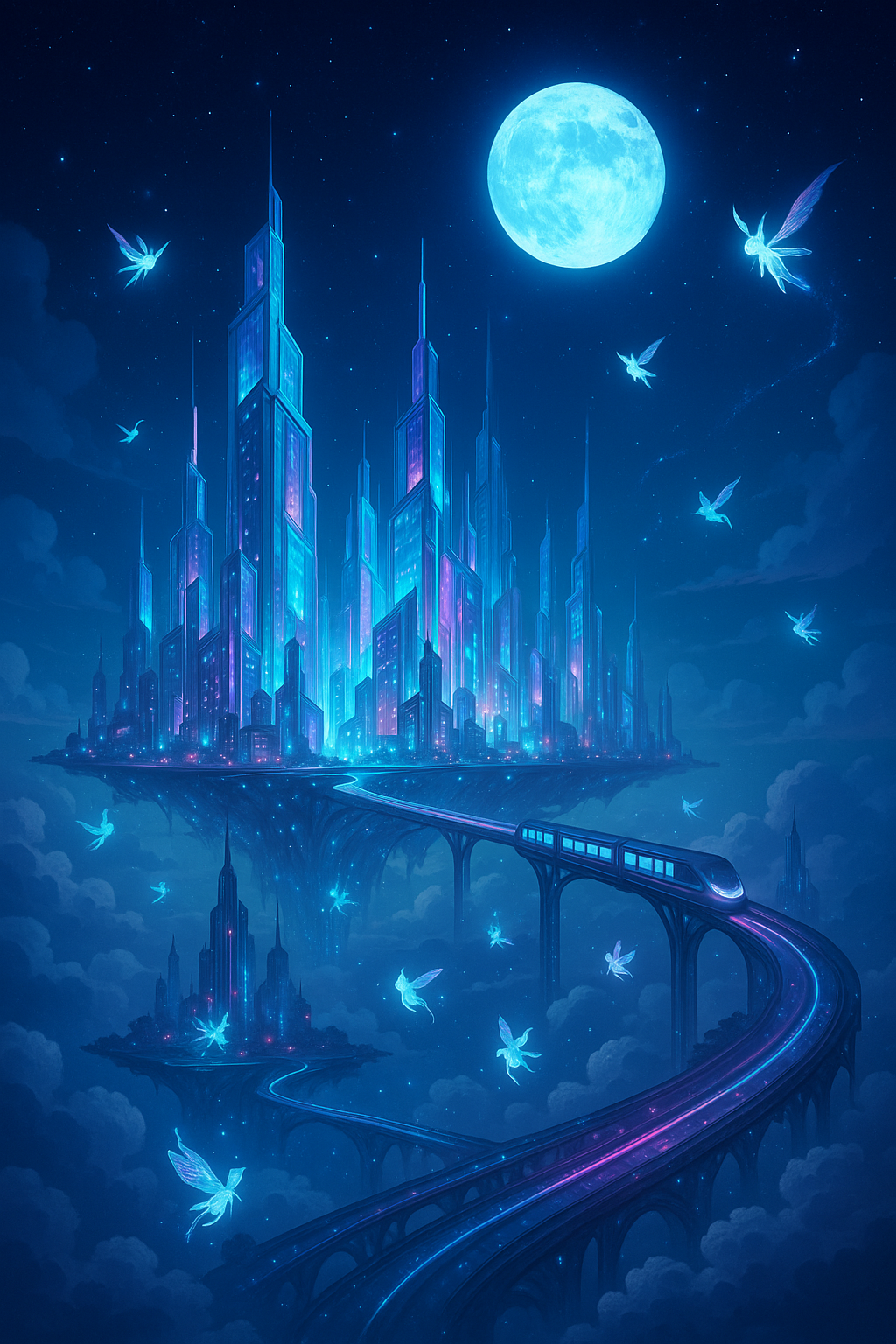
And so the story ends — or rather, it pauses, for the story of Noctura has no true ending, any more than a dream has a final page. The city that was born from a spark of imagination in the primordial void continues, luminous and alive, bathed now in the golden light of its first sun and the silver glow of its ancient nebula, both coexisting in a sky that has learned to hold contradictions as gently as a hand holds a candle.
If you were to visit Noctura today — and some say you can, if you know how to dream with sufficient intensity and in the right direction — you would find it changed, and unchanged. The same crystal spires still rise against the sky, though they catch the sunlight differently now, fragmenting it into rainbows that cascade through the streets like living rivers of color. The same floating pathways still connect the districts, though they glow brighter in the new light, their edges rimmed with a warmth that the eternal twilight never provided.
The Dream Core still pulses at the city's heart, though its rhythm has evolved — deeper, steadier, more confident, like a heart that has survived a great transformation and found itself stronger for it. The Wonderists still tend it, still study it, still marvel at the impossibility of a machine powered entirely by imagination. But they no longer worry about it fading, because they understand now that dreams do not diminish in sunlight. They simply become visible to everyone, not just the dreamers.
"Noctura was never just a city. It was an argument — the most beautiful argument ever constructed — that imagination is not an escape from reality, but the very foundation upon which reality is built."
The Stardust Riders still race through the sky, though they ride higher now, spiraling up into the blue where the nebula parts and the stars are clear and close. They've mapped new routes — sun-routes, they call them — that follow the warm currents of heated air that rise from the sunlit buildings below. The young riders say it's the best era to be alive. The old riders say every era is the best era to be alive, and that the real trick is remembering it.
The Floating Market has expanded, as markets do, sprouting new stalls that sell goods unique to the post-sunrise era: prisms that capture and replay the rainbow-light, sundials that tell time by measuring the angle of joy, sunglasses crafted from crystallized twilight for citizens who occasionally miss the softness of their former sky. Memory merchants still sell bottled remembrances, and the most popular new offering is a memory of the moment the sun first appeared — a Vesper of such concentrated wonder that customers often weep when they experience it, regardless of whether they were actually there.
The Emotion Sky is more nuanced now, its palette expanded by the interaction between nebula-light and sunlight. Colors that were never possible before appear daily — a sunrise-gold threaded with nostalgic amber, a joyful pink deepened by the blue of midday sky. The Sky Readers have had to invent entirely new vocabularies to describe the shades they observe, and they do so with the giddy enthusiasm of children who have been given an extra box of crayons.
Solenne still plays the Light-Harp, and the annual concert is more spectacular than ever. In sunlight, the crystallized notes take on a fire and brilliance that makes the night concerts seem like rehearsals. But Solenne — wise, quiet, eternal Solenne — has begun incorporating something new into her performances: silence. Long, deliberate pauses between movements where no note sounds and no light shines, where the audience sits in perfect stillness and listens to the most important music of all — the sound of their own hearts beating, their own lungs breathing, their own consciousness humming with the simple, terrifying, magnificent fact of being alive.
And in the Hall of Dreams, the Nexus has awakened.
Not fully — perhaps not ever fully, for a consciousness made of dreams may always exist in a state of partial wakefulness, like a sleeper on the edge of morning who can hear the birds but has not yet opened their eyes. But it is aware now, in its own way. It speaks — not in words, but in dreams, sending visions to the Keepers that contain questions, observations, and what can only be described as opinions. It likes the sunrise. It finds the new colors fascinating. It has asked, through a dream delivered to the Archivist on a quiet Tuesday, whether there are other cities out there — other places where imagination has taken root and grown into something that breathes.
The Archivist smiled when they received this dream, because they knew the answer. Yes. There are other places. Everywhere a mind imagines something that does not yet exist, everywhere a child builds a castle in the air, everywhere a dreamer closes their eyes and sees what is not there but could be — there, in that luminous space between thought and reality, something is growing. Something that might, one day, if it is tended and trusted and loved, become as real and as beautiful as Noctura.
"Every night, across every world and every dimension, billions of beings close their eyes and dream. Most of these dreams are forgotten by morning. But not all of them. Some of them — the brightest, the bravest, the most stubborn — refuse to disappear when the dreamer wakes. They linger, and they grow, and they wait. And sometimes — just sometimes — they build cities."
This is the truth that Noctura teaches, the truth it was built to embody, the truth that every floating street and crystal spire and glowing Vesper in the Hall of Dreams proclaims to anyone with the courage to listen: that imagination is not a luxury. It is not an indulgence or an escape or a waste of time. It is the most powerful force in existence — more powerful than gravity, more persistent than time, more creative than evolution. It is the force that looked at a void and said, "This should be a city." And it was.
So tonight, when you close your eyes and feel yourself sinking into the warm, dark waters of sleep, pay attention. Pay attention to the shapes that form behind your eyelids, the stories that unspool without your permission, the worlds that construct themselves from nothing more than the electricity in your neurons and the yearning in your heart. Pay attention, because those are not idle fantasies. Those are blueprints.
And somewhere — in a dimension you haven't found yet, in a space between the stars where physics takes a holiday and possibility reigns supreme — a city is listening for your dream. It has been listening for a long time. It has a place prepared for your particular vision, a crystal alcove in the Hall where your dream will be preserved beside billions of others, each one a small, bright argument against the darkness.
Dream boldly. Dream recklessly. Dream as if the fate of a floating city depends on it.
Because, somewhere, it does.
— The End —