Long before the first sun ignited and the galaxies learned to spin, there existed a vast, silent expanse — a canvas of absolute darkness that stretched beyond comprehension. It was not empty, however. Within this primordial void hummed a quiet frequency, a vibration so subtle that only the universe itself could hear it. It was the frequency of potential — the sound of everything that could ever be, waiting patiently to become.
And then, somewhere in that infinite stillness, something extraordinary happened. A single thought flickered into existence — not from any living being, for none yet existed, but from the void itself. It was a thought without words, a feeling without form: the desire to create. And from that desire, a spark was born — a spark made not of fire, but of pure, undiluted imagination.
The spark drifted through the darkness for what might have been a moment or a millennium — time had not yet learned to keep count. It pulsed gently, growing brighter with each beat, as if it were a tiny heart learning to feel for the first time. Around it, the darkness began to ripple, and from those ripples, light began to emerge — not the harsh light of stars, but something softer, warmer. A light that felt like memory.
"The city did not appear all at once. It emerged the way a dream emerges — slowly, then suddenly, then all at once — as if it had always been there, simply waiting to be noticed."
From this cosmic seed of imagination, structures began to form. They were delicate at first — translucent spires that rose like frozen breath in winter air, their surfaces catching light that shouldn't exist and scattering it into colors that had never been named. Bridges appeared next, arcing between the spires in graceful parabolas, their surfaces smooth as polished thought. Streets materialized beneath them — not of stone or metal, but of compressed starlight, each footstep creating a soft chime that echoed through the nascent city like wind through a crystal forest.
This was the birth of Noctura.
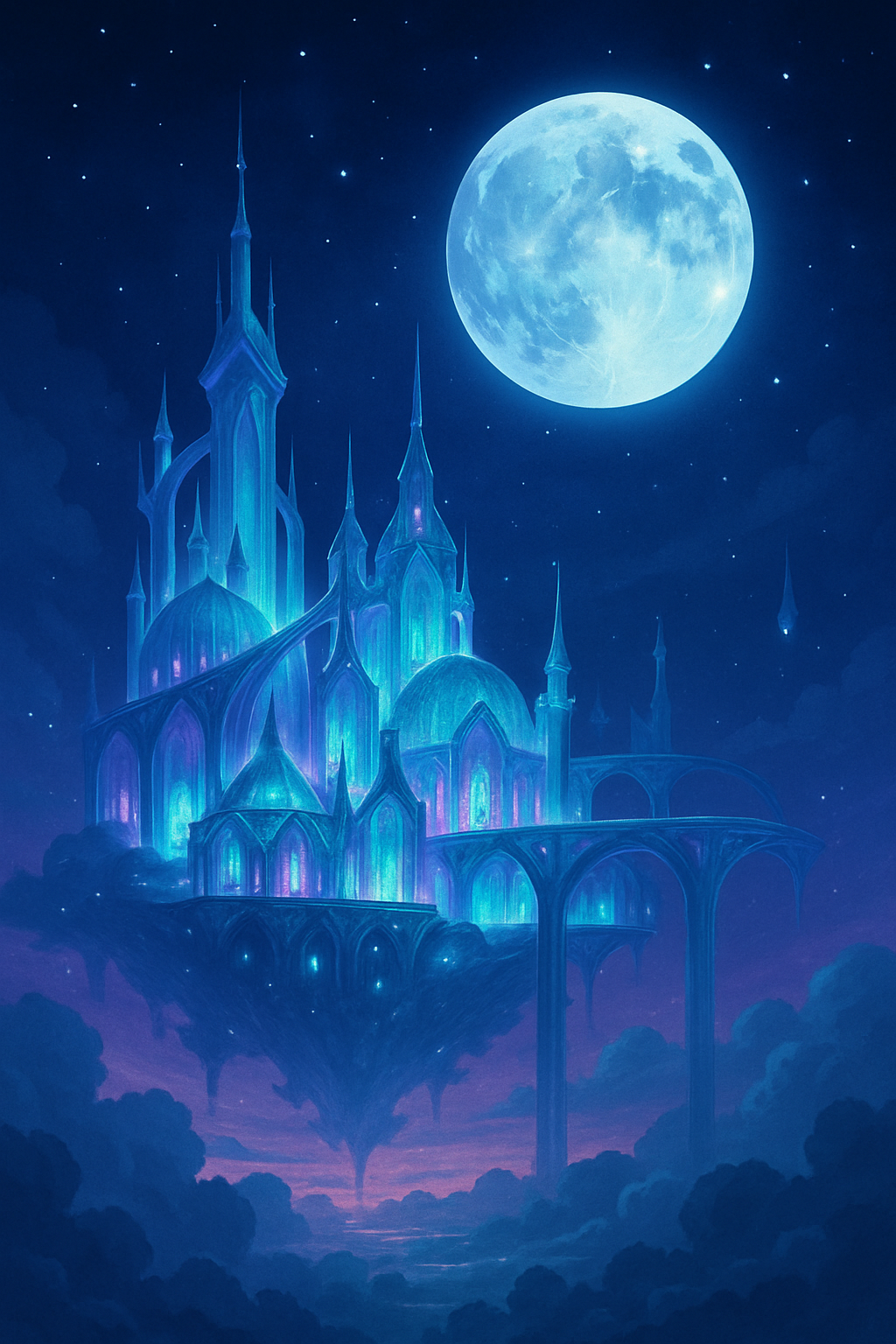
The city hung in the space between dimensions, anchored to nothing and everywhere at once. It was not built — it was dreamed into being. Every wall, every window, every winding staircase was a fragment of someone's deepest imagination made manifest. The foundations were laid not in earth but in belief, and the mortar that held everything together was wonder itself.
In its earliest moments, Noctura was small — no larger than a village square — but it pulsed with an energy that suggested infinite potential. The air tasted of possibility. The sky above wasn't really a sky at all but a vast expanse of swirling nebulae, their colors shifting like oil on water, painting the city in perpetual twilight hues of indigo, violet, and deep cerulean.
The first beings to discover Noctura were the Dreamwalkers — ethereal entities who existed in the liminal spaces between consciousness and sleep. They were drawn to the city like moths to a flame that burned with ideas rather than fire. When they arrived, they wept — not from sadness, but from recognition. They had been dreaming of this place their entire existence without ever knowing it had a name.
The Dreamwalkers settled into Noctura and began to shape it with their presence. Each one brought with them the echoes of dreams they had witnessed across countless sleeping minds — dreams of flying over silver oceans, dreams of talking to stars, dreams of gardens where every flower was a different melody. These fragments of imagination wove themselves into the very fabric of the city, making it richer, deeper, more alive with each passing moment.
And so Noctura grew. It grew not outward like cities of stone and steel, but inward, becoming more complex, more layered, more impossibly beautiful. Each new dream added another dimension, another possibility, another reason to believe that the impossible was simply the possible waiting for permission.
"Noctura was alive — truly, deeply alive. Not in the way a tree or an animal is alive, but in the way a song is alive — existing only because someone believes in it enough to keep singing."
The city glowed perpetually, casting its light upward into the dimensional rift from which it hung, appearing to distant observers like a second moon — mysterious, beautiful, and forever just out of reach. Those who saw it from afar felt an ache in their chests, a longing for something they couldn't name. Artists tried to paint it. Poets tried to describe it. Philosophers tried to explain it. But Noctura defied all attempts at capture. It existed in the space between words, in the breath between notes, in the moment between closing your eyes and the first frame of a dream.
And within its crystalline walls, under its nebula sky, the city waited. It waited for more dreamers. It waited for more stories. It waited for the moment when someone would look up at the strange light in the sky and wonder, just for a heartbeat, if cities could truly sleep among the clouds.
Because in Noctura, wondering was the same as arriving.