No architect ever drew blueprints for Noctura. No engineer ever calculated its load-bearing capacities or tested the tensile strength of its bridges. The city's architecture was born from something far more powerful than mathematics — it was born from the raw, unfiltered force of creative thought, sculpted by hands that understood that the only true limit was the boundary of imagination itself.
The towers of Noctura were its most striking feature. They rose from the luminous streets like frozen geysers of light, each one unique, each one impossible. The Tower of Infinite Stairs was perhaps the most famous — a spiraling structure that appeared to wind upward forever, its staircase curving inward upon itself in an Escher-like paradox. Those who climbed it reported that every hundred steps, reality shifted slightly: gravity would tilt, colors would change, and occasionally you'd find yourself walking on the ceiling without having noticed the transition. The tower had no top. Or perhaps it had infinite tops. Visitors disagreed, and both sides were correct.
Nearby stood the Crystal Basilica, a cathedral-like structure made entirely of crystallized emotions. Its walls were formed from joy — translucent and warm to the touch, radiating a golden light that made everyone who entered feel, just for a moment, like everything in every universe was going to be perfectly fine. The ceiling was woven from curiosity — prismatic and constantly shifting, revealing new patterns and colors depending on who looked at it and what questions lived in their heart.
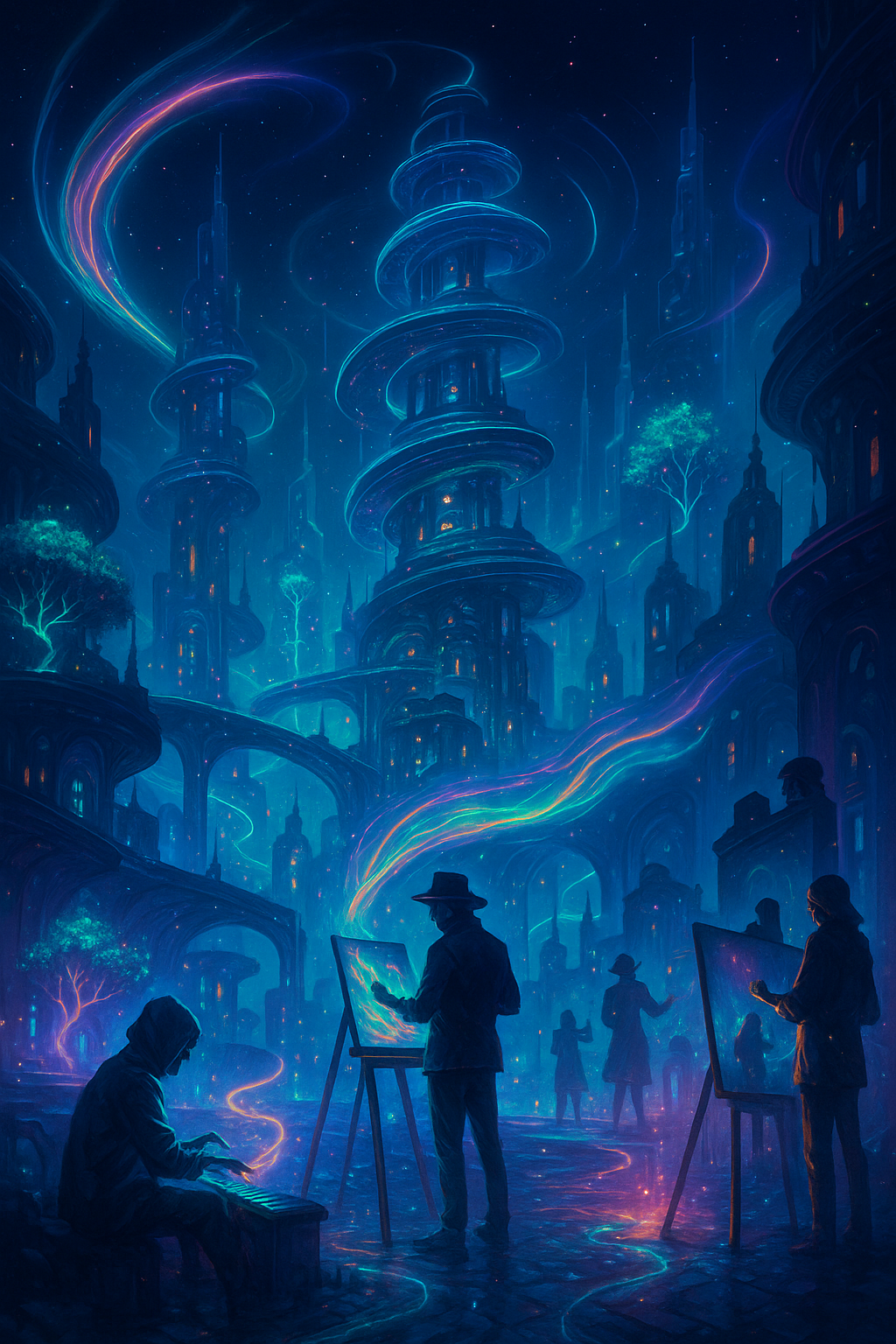
"In Noctura, a building was not something you looked at. It was something that looked back at you — and changed itself based on what it saw."
The bridges of Noctura were living things. They grew organically between towers, responding to the needs and desires of the city's inhabitants. When a citizen wished to visit a friend across the cityscape, a bridge would begin to form — slowly at first, a tendril of light stretching across the gap, then solidifying into a walkway of polished thought. Some bridges were broad and welcoming, designed for social gatherings and promenades. Others were narrow and intimate, meant for private crossings and whispered conversations.
The most remarkable bridge was the Empathy Span — a structure that connected the two most distant points of the city. Walking across it, travelers experienced fragments of emotions from every citizen they passed over. A burst of joy here, a flicker of nostalgia there, a deep pulse of love that made your knees weak. By the time you reached the other side, you understood everyone in Noctura a little better. Many citizens walked the Empathy Span daily, not to get somewhere, but to feel connected to their community in the most literal sense possible.
But the city's true architectural marvels were its gardens. In Noctura, gardens didn't simply grow — they were wished into existence. A citizen might pause at an empty corner, close their eyes, and whisper a wish for beauty, and from the luminous ground, a garden would begin to sprout. But these were no ordinary gardens. The flowers were three-dimensional melodies — each petal a note, each stem a rhythm, each garden a symphony that played continuously for anyone who walked through it.
The Garden of First Thoughts was the oldest in the city, planted by the original Dreamwalkers. Its flowers were made of pure ideas — concepts that had never been thought before, growing on stems of possibility. People came from across dimensions to walk through it, and many left with entirely new philosophies, scientific theories, or artistic movements forming in their minds. It was said that every great innovation in any universe could be traced back to a seed from this garden.
Artists from across galaxies made pilgrimages to Noctura, drawn by its reputation as a place where creation had no limits. They arrived with empty canvases and left with masterpieces that couldn't exist anywhere else. Painters discovered they could paint with sound, creating visual symphonies that audiences could both see and hear. Sculptors found they could carve emotions directly from the air, shaping sadness into delicate figurines and joy into towering monuments. Writers learned to craft stories that their readers could physically enter, walking through narratives like tourists through a city.
The architecture of Noctura was not static. It breathed. It grew. It responded. Every thought, every feeling, every dream contributed to its evolution. Buildings that were loved grew taller and more ornate. Streets that were frequently walked became smoother and began to hum with the footsteps of their visitors. Rooms remembered the conversations held within them and would occasionally whisper fragments of old discussions to new occupants, creating an oral history written in architecture.
"The laws of physics hadn't been broken in Noctura. They had simply been politely asked to wait outside while imagination finished redecorating."
As the city expanded, its architectural language became increasingly complex. New forms appeared that defied description in any known vocabulary — structures that were simultaneously inside and outside, buildings that existed in multiple dimensions at once, rooms that were bigger on the inside because they contained the dreams of everyone who had ever entered them.
And still, the city asked for more. More dreams. More ideas. More whispered wishes at empty corners. Because in Noctura, every empty space was an invitation, and every invitation was a promise: that whatever you could imagine, this city would help you build.