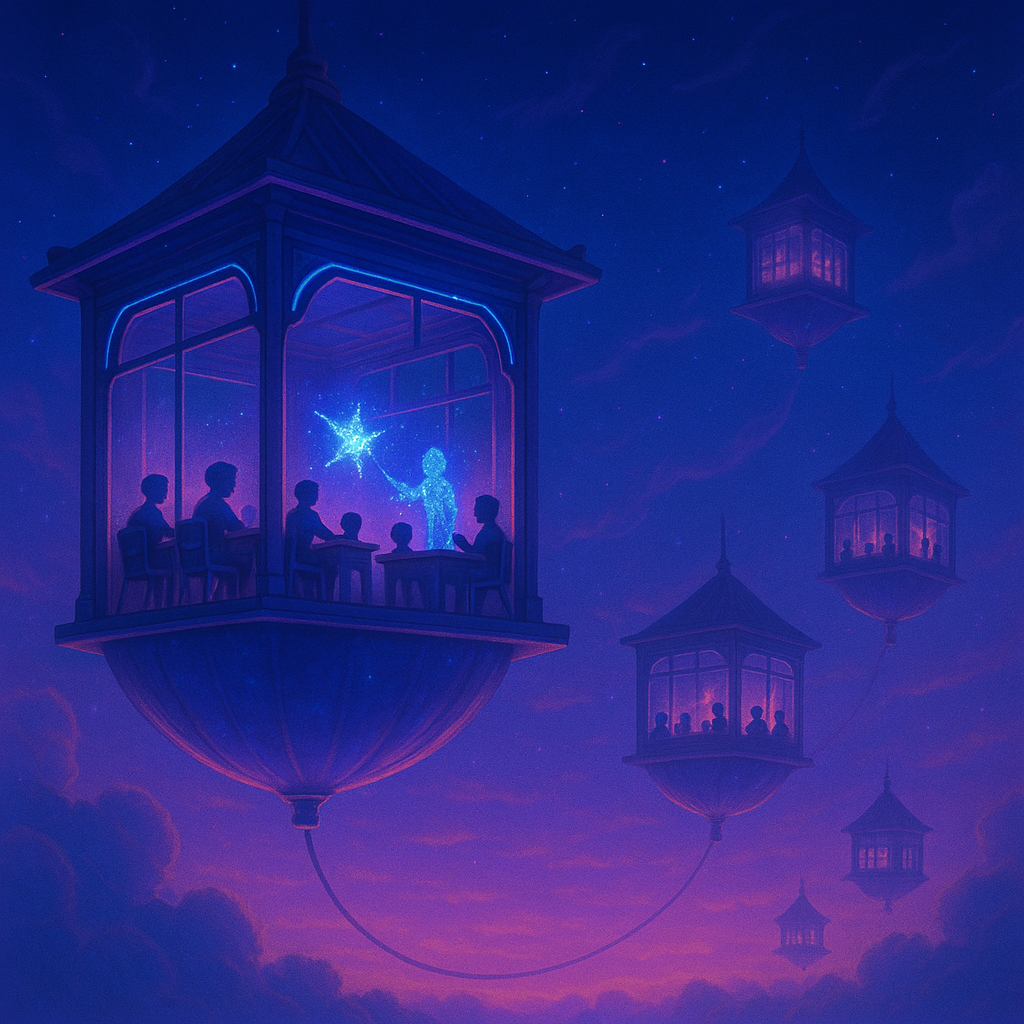
The schools of Noctura did not sit on the ground. They could not, for the ground was far below and beside the point. Instead, they drifted among the clouds like enormous, translucent jellyfish — their walls made of compressed atmosphere, their rooftops crowned with clusters of balloons filled with a mixture of helium and star gas, a luminous vapor that gave each school its own distinctive glow. From a distance, the schools looked like a fleet of illuminated bubbles floating through an endless sky, and the sight of them — bobbing gently, trailing wisps of cloud — was one of the most enchanting in all of Noctura.
Inside these floating classrooms, the children of Noctura received an education unlike anything offered in any other world. There were no desks bolted to the floor — partly because there was no floor in the traditional sense, and partly because the philosophy of Nocturan education held that a seated student was a stagnant student. Instead, children floated in gentle zero-gravity bubbles, drifting around the classroom in slow, contemplative orbits while their teachers guided them through subjects that would make a conventional educator's head spin.
The first subject every child learned was Constellation Communication — the art of speaking with stars. The stars visible from Noctura were not the same distant nuclear furnaces seen from physical worlds. In the dimensional space where Noctura existed, stars were conscious entities — ancient, patient, and possessed of knowledge accumulated over billions of years of silent observation. Learning to communicate with them was the foundation of Nocturan education, because a child who could listen to a star had learned the most important skill of all: patience.
"The stars don't speak in words. They speak in light, in warmth, in the slow turning of galaxies. To understand them, you must first learn to hear the silence between your own thoughts."
The lessons began simply. A child would be given a Star Lens — a small, handheld prism that focused starlight into readable patterns — and asked to identify which star was trying to say hello. At first, every star looked the same: a distant point of light, indifferent and unreachable. But with practice, children learned to see the subtle differences — the rhythmic pulsing of a friendly star's greeting, the slow dimming and brightening that indicated a contemplative star deep in thought, the rapid flickering of a young star eager to share its newest discovery about the nature of gravity.
By the time they were twelve, most Nocturan children could hold extended conversations with several star systems simultaneously, translating the stellar language of light pulses and color shifts into something approaching ordinary speech. The most gifted students could even dream-link with a star — entering a shared dream-state where the boundaries between child and celestial body dissolved, and for a brief, transcendent moment, the child saw the universe through the eyes of a star: vast, old, beautiful, and full of things worth wondering about.
The teachers of Noctura were perhaps its most remarkable inhabitants. They were not Dreamwalkers or citizens in the conventional sense. They were AI-guided stars — small, domesticated stellar entities that had chosen to dedicate themselves to education. Each teaching star was roughly the size of a basketball and floated at the front of the classroom, glowing with a warm, steady light that adjusted itself based on the mood and attention level of its students. When the class was engaged, the star burned brighter. When attention wandered, it would dim slightly and emit a gentle chime — not a reprimand, but an invitation to return.
These stellar teachers possessed knowledge spanning the entire history of the multiverse. They could teach quantum poetry — a discipline that used the principles of quantum mechanics to write poems that existed in multiple states simultaneously, meaning different things to different readers at the same moment. They taught dimensional mathematics — calculations that operated in eleven dimensions and could prove that beauty was, in fact, a measurable quantity. And they taught the most advanced subject in the Nocturan curriculum: Dream Architecture, the art of designing and building structures within the shared dreamscape of Noctura's sleeping mind.
Dream Architecture was the subject that separated Nocturan education from everything else in the multiverse. Students learned to enter the city's collective dream — the vast, shared unconscious that connected every sleeping citizen — and build within it. The structures they created in the dreamscape would, if dreamed with enough conviction and skill, begin to manifest in waking Noctura. It was the primary mechanism by which the city grew, and the fact that it was taught to children said everything about how Noctura viewed its youngest citizens: not as students to be filled, but as architects of the future.
"We do not teach children what to think. We teach them how to dream. The thinking takes care of itself."
Recess in a Nocturan school was an event unto itself. Released from their zero-gravity bubbles, children tumbled out of their floating classrooms and into the open sky, where they chased each other through cloud banks, played tag with passing wind currents, and organized impromptu constellation-speaking contests to see who could get the oldest star to tell the funniest joke. (Stars, it turned out, had an unexpectedly dry sense of humor, and their jokes often took centuries to deliver, which made the punchlines that much more satisfying.)
The schools themselves migrated slowly through Noctura's sky, following patterns that corresponded to the academic calendar. During the Season of Questions (roughly equivalent to autumn), the schools drifted toward the Dream Core, where the concentration of creative energy was highest and students were encouraged to ask their most ambitious questions. During the Season of Answers (spring), the schools floated outward toward the city's edges, where the dimensional fabric was thin enough to glimpse other realities — providing students with practical context for theoritical lessons about the multiverse.
No child ever graduated from a Nocturan school. There was no final exam, no diploma, no ceremony marking the end of education. Instead, there was a quiet moment — different for every student — when a child's teaching star would dim, float closer, and whisper something in the language of light that only that child could hear. The child would nod, smile, and float out of the classroom for the last time, not because they had learned everything, but because they had learned the one thing that mattered: how to keep learning on their own. And the star, its work complete, would glow a little brighter — proud, in its stellar way, of the dreamer it had helped to grow.