Every civilization has its wonders — its pyramids, its cathedrals, its great walls and towering monuments. But Noctura's most awe-inspiring marvel was not something that was built. It was something that happened every evening, as naturally and inevitably as a heartbeat, transforming the entire sky into a living, breathing work of art that reflected the collective soul of a city that had learned to wear its heart on its atmosphere.
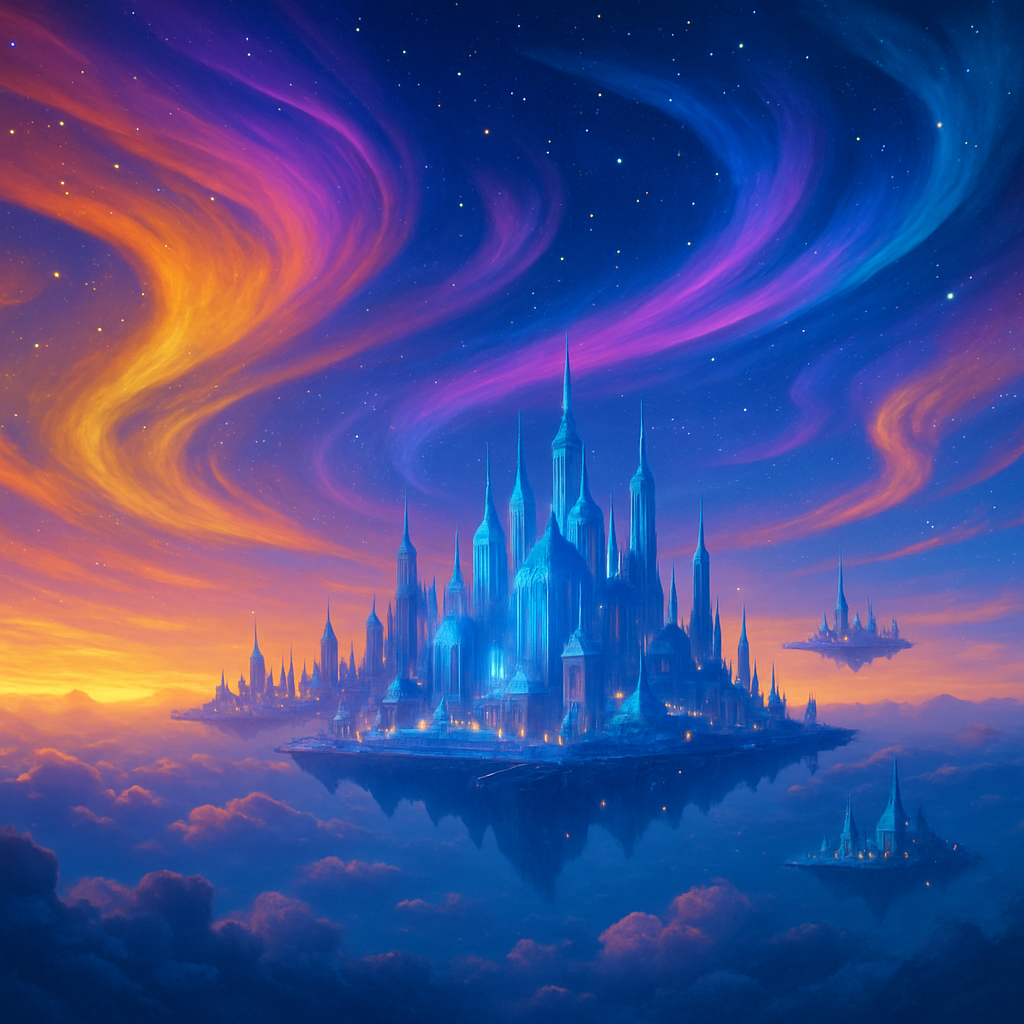
The phenomenon was called the Emotion Sky, and it worked like this: as the nebula above Noctura cycled through its eternal twilight, the light that filtered through it began to respond — not to atmospheric conditions or solar activity, but to the emotions of every living being in the city below. It was as if the sky were a vast, sensitive membrane, vibrating in sympathy with the feelings of those who lived beneath it, translating the invisible language of the heart into a spectacular display of color and light that no artist could replicate and no photograph could capture.
The connection between emotion and sky was not metaphorical. It was a genuine, measurable phenomenon — one of the many impossibilities made possible by the Dream Core's influence on the dimensional fabric in which Noctura existed. Wonderists had mapped the correlations over centuries of observation, creating an emotional color atlas that read like poetry disguised as science.
"The sky doesn't judge your feelings. It simply wears them — beautifully, honestly, without reservation. If only we could be so brave."
When joy prevailed — during festivals, celebrations, or simply on those days when the collective mood was bright and buoyant — the sky turned golden. Not the pale gold of earthly sunsets, but a deep, saturated gold that seemed to emanate warmth itself, wrapping the city in a light that made everyone and everything look noble and beautiful. The golden sky was Noctura's most common evening color, a fact that visitors found remarkable and citizens considered simply right.
When curiosity dominated — when the schools were in session and the markets were buzzing with new discoveries — the sky painted itself in swirling violet. Not a single, uniform shade, but a complex tapestry of lavenders, amethysts, and deep purples that spun and eddied like watercolors in slow motion. The violet sky was mesmerizing, and scholars noted that their best ideas tended to arrive on violet evenings, as if the sky's curiosity fed their own.
But the Emotion Sky's palette extended far beyond gold and violet. Love, when it swelled through the city — during wedding seasons, or on those quiet evenings when the simple act of existing beside someone you cherished felt like the greatest privilege in any universe — turned the sky a deep, blushing rose that deepened to crimson at the edges. Couples would lie on floating platforms and watch the sky deepen around them, knowing they were contributing to its color simply by being together.
Nostalgia produced the most complex colorscape — a shifting gradation of amber, sepia, and soft gray that looked like a watercolor painting left in the rain. It appeared most often during the Season of Remembering, when citizens honored departed loved ones by sharing memories at the Dream Core. The nostalgic sky was bittersweet and beautiful, and many citizens considered it their favorite, because it reminded them that the ability to miss someone was itself a form of love.
Wonder — a particularly common emotion in Noctura — turned the sky an iridescent opal, shifting between every color in rapid, unpredictable succession. This happened most often when something new appeared in the city: a building that materialized overnight, a new species of dream-flower in the gardens, or the arrival of a visitor from a dimension no one had heard of before. The opal sky was electric, buzzing with potential, and citizens learned to look up when they saw it, because it meant something extraordinary was happening somewhere.
The rarest sky was the Silver Sky, which appeared perhaps once in a generation. It occurred when every citizen of Noctura felt the same emotion at the same moment — a feat of collective synchronization that was nearly impossible in a city of dreamers, each with their own inner world. The Silver Sky was said to be so beautiful that it could make even the stars weep, though the stars themselves insisted they were merely unusually condensed in the upper atmosphere and the moisture was entirely coincidental.
"I have traveled through seventeen dimensions, witnessed the birth of binary stars, and stood at the edge of reality where everything becomes mathematics. But nothing — nothing — compares to watching Noctura's sky blush gold because an entire city is happy at the same time."
There was a profession in Noctura dedicated to the Emotion Sky: the Sky Readers. These were individuals with an unusually refined sensitivity to the sky's chromatic shifts, able to read subtle variations in hue and intensity the way a musician reads sheet music. Sky Readers served many roles — as counselors who could identify neighborhoods experiencing collective distress, as celebrants who could predict when the sky would display its most spectacular colors, and as historians who recorded each evening's sky-painting in meticulous detail, creating archives of the city's emotional history that stretched back to its earliest days.
Children in Noctura grew up with an emotional vocabulary far richer than their counterparts in any other world, because they learned to name feelings not from textbooks but from the sky itself. "Today is a lavender-gold day," a child might say, meaning they felt both curious and happy. "The sky is going cerulean," another might observe, recognizing the onset of peaceful contemplation. The sky taught them that emotions were not things to be hidden or controlled but displayed — beautifully, honestly, as naturally as light through a prism.
And every evening, as the sky performed its quiet, magnificent transformation, the citizens of Noctura would pause — whatever they were doing, wherever they were — and look up. It was the city's most universal ritual, more widespread than any religion, more consistent than any routine. They looked up, and they saw themselves — their joys, their sorrows, their loves, their wonders — painted across the infinite canvas above them. And in that moment of recognition, the sky would glow just a little bit brighter, because seeing yourself clearly is its own form of light.