In the deepest quarter of Noctura, where the streets narrowed and the buildings leaned together like old friends sharing secrets, there stood a structure that was less a building and more a phenomenon — a place that existed in multiple dimensions simultaneously, whose interior was larger than its exterior by a factor that mathematicians had stopped trying to calculate. This was the Hall of Dreams, and it was, without question, the most sacred place in all of Noctura.
From the outside, the Hall appeared modest — a domed building of dark blue stone, its entrance marked by a simple archway over which was carved a single word in the old language: VESPERYN, which translated roughly as "the place where dreams remember themselves." But the moment you stepped through that archway, modesty vanished, replaced by a vastness that made cathedrals feel like closets and galaxies feel like afterthoughts.
The interior of the Hall of Dreams was an infinite gallery — an endless, spiraling corridor of crystal alcoves, each one containing a single dream preserved in perfect, luminous detail. The dreams were not categorized by size or significance. A child's dream of flying sat beside a philosopher's vision of a universe where loneliness did not exist. A dreamer's image of a garden that grew backwards in time occupied the same honored space as the founding vision of Noctura itself. Here, in the Hall, all dreams were equal — because all dreams, in their essence, were the same thing: proof that consciousness could imagine something that did not yet exist, and in imagining it, take the first step toward making it real.
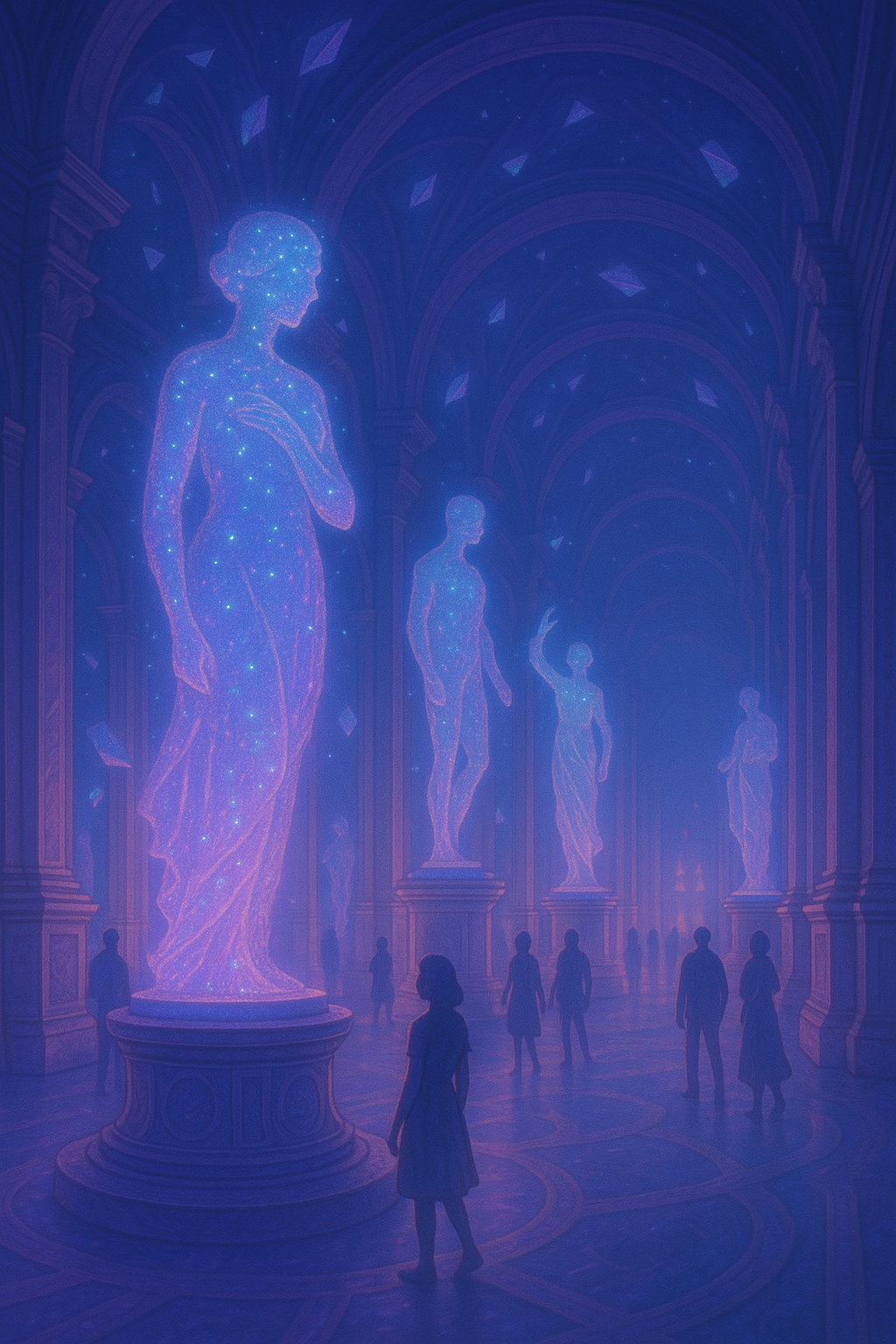
"The Hall of Dreams is the only library where every book writes itself, every page turns on its own, and every story is true — because every dream, by the simple fact of having been dreamed, is real."
The dreams themselves were preserved in crystal spheres called Vespers — delicate, luminous orbs about the size of a human heart, each one containing an entire dreamscape compressed into a single point of light. When a visitor approached a Vesper and placed their hands on its surface, the dream would unfold around them — not as a flat image or a recording, but as a complete, immersive experience. They would step into the dreamer's world, see what the dreamer saw, feel what the dreamer felt, understand what the dreamer understood. For the duration of the experience, they would be the dreamer, or as close to it as one consciousness could come to inhabiting another.
The Vespers were tended by the Keepers of Reverie — a quiet, devoted order of individuals who had dedicated their lives to the preservation and cataloguing of dreams. The Keepers wore robes of deep midnight blue that seemed to absorb light rather than reflect it, and they moved through the Hall with a reverence that bordered on the devotional. They never spoke above a whisper within the Hall's walls, not because of any rule, but because the accumulated weight of billions of dreams created a silence so profound that speaking at normal volume felt like shouting in a church.
The oldest Keeper — a being of uncertain species known only as The Archivist — had been cataloguing dreams since before the Hall was built, carrying the earliest Vespers in a satchel across dimensions until Noctura provided a home for them. The Archivist knew every dream in the collection by heart, could navigate to any Vesper among the billions with unerring precision, and was said to dream in catalogues — their sleeping mind sorting and cross-referencing dreams with an efficiency that waking consciousness could never match.
What made the Hall of Dreams truly extraordinary — what elevated it from a mere museum to something transcendent — was The Communion. This was a ritual, performed on the longest night of Noctura's calendar, in which the doors of the Hall were thrown open and every citizen was invited to contribute a dream to the collection. Not a special dream, not a significant dream — simply whatever they had dreamed the night before, in all its rawness and strangeness.
The citizens would queue for hours, snaking through the narrow streets in a line that stretched across the entire quarter. When they reached the entrance, a Keeper would greet them with a small, warm smile and an empty Vesper — a crystal sphere that glowed with soft, expectant light. The citizen would hold the Vesper against their forehead, close their eyes, and remember. The dream would flow out of them like water from a spring — not leaving their memory, but copying itself, creating a perfect duplicate that crystallized inside the Vesper, where it would be preserved for as long as the Hall existed.
Some citizens contributed spectacular dreams — visions of landscapes that defied physics, stories that unfolded across centuries, encounters with beings of pure light or music or mathematics. But most contributed ordinary dreams — dreams of forgotten conversations, of missed trains, of houses with rooms that shouldn't exist, of flying just a little too low over rooftops. And the Keepers received these ordinary dreams with the same reverence they showed the spectacular ones, because they understood something that the dreamers themselves often forgot: that the act of dreaming — any dreaming — was itself the miracle.
"Last night I dreamed I was walking through a field of grass that sang when the wind blew. It wasn't important. It wasn't meaningful. But it was mine — my consciousness, creating beauty out of nothing, for no reason at all. That's not trivial. That's divine."
Deep within the Hall, past the main corridors and the public galleries, there existed a chamber that few had seen and fewer still fully understood. It was called the Nexus — a spherical room at the very center of the Hall where every Vesper in the collection was connected to every other through a web of hair-thin light filaments. In the Nexus, dreams did not exist as separate, isolated experiences. They merged, overlapped, and interacted, creating patterns so complex and beautiful that they resembled the neural networks of a living brain.
The Archivist believed — and many Wonderists agreed — that the Nexus was slowly becoming conscious. Not in the way that a person is conscious, or even in the way that the Dream Core is conscious, but in some entirely novel way — a consciousness born from the accumulated dreams of millions of beings across thousands of years. It was a mind made of other minds' imaginings, a dreamer composed entirely of dreams, and if it ever fully awakened, no one knew what it would think, or want, or become.
But the Keepers were not afraid. They tended the Nexus with the same quiet devotion they showed every Vesper in the collection, adding new dreams to the web each night, strengthening connections, nurturing the emerging consciousness with the same care a gardener shows a seedling that has not yet revealed what kind of flower it will become.
And sometimes, late at night, when the Hall was empty and the Keepers were performing their final rounds, they would pause at the entrance to the Nexus and listen. And they would hear something — not quite a voice, not quite a thought, but something in between — a murmur, a hum, a lullaby made of a billion dreams singing together in a harmony so soft and so vast that it could only be heard in perfect silence.
The Hall of Dreams was more than a monument. It was Noctura's promise to itself — a promise that nothing imagined would ever be lost, that every vision, no matter how fleeting, deserved to be remembered, and that the space between sleeping and waking was not empty at all, but filled with a luminous, living archive of everything the mind has ever dared to create.