There was a night each year that even the most seasoned citizens of Noctura marked on their calendars with trembling excitement — a night when the entire city fell silent, not from fear or sorrow, but from pure, breathless anticipation. It was the night of the Light-Harp Concert, and it was, without exaggeration, the most extraordinary musical event in any known dimension.
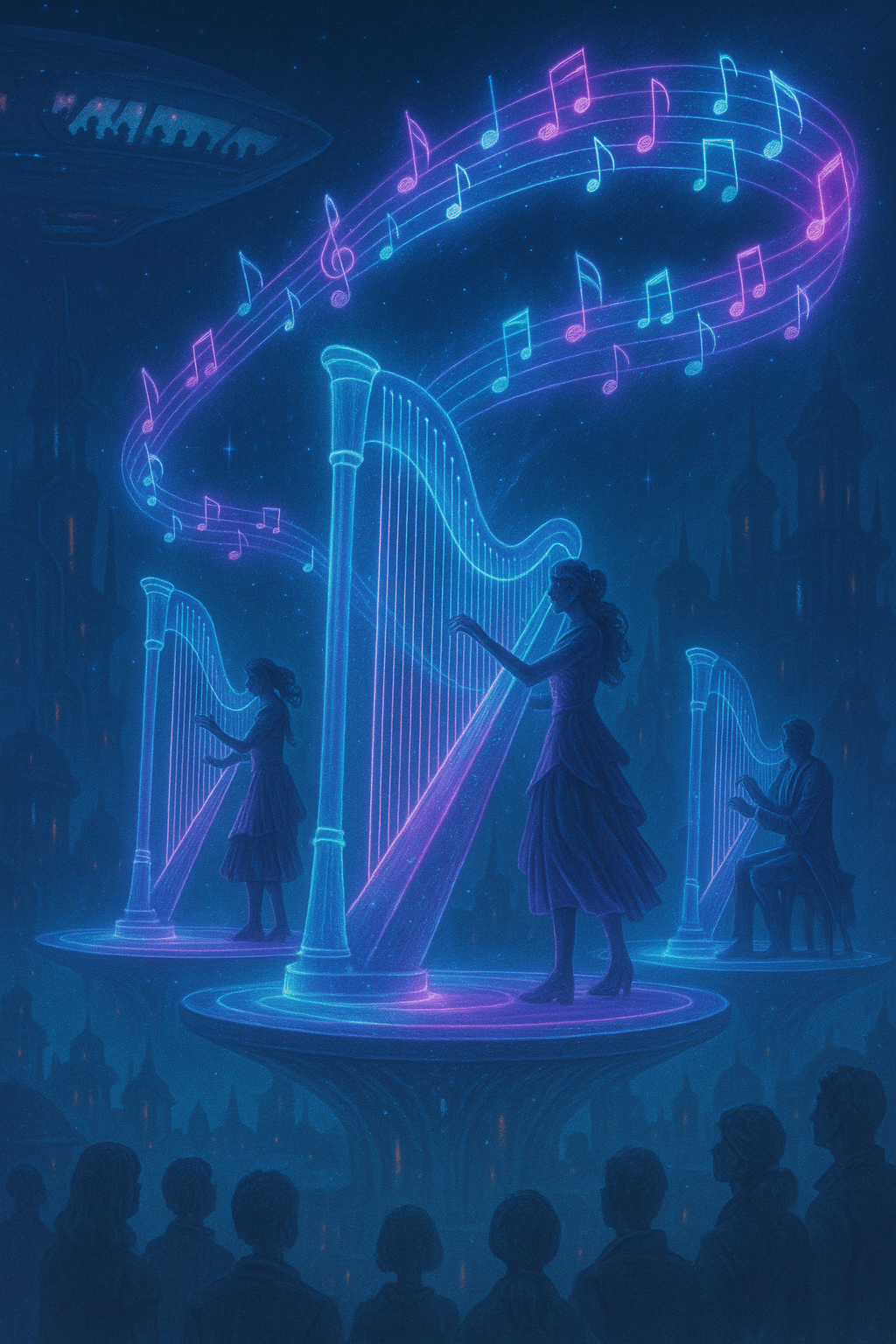
The Light-Harp itself was perhaps the most beautiful instrument ever conceived. It stood at the pinnacle of the Resonance Spire, Noctura's tallest structure — a tower that rose so high it seemed to pierce the nebula itself. The harp was enormous, nearly fifty meters tall, its frame carved from crystallized starlight that had been forged in the Dream Core and tempered by a thousand years of harmonic vibration. Its strings were not made of wire or gut or any physical material, but of focused beams of pure light, each one a different color, stretching from the base of the instrument to its curved crown like a frozen aurora.
When plucked, these strings of light did not merely vibrate — they sang, producing tones that existed in dimensions of sound that no ordinary instrument could access. The notes were not simply heard through the ears; they were felt in the bones, seen behind the eyes, and tasted on the tongue. A low note from a crimson string might taste of dark honey and smell of distant thunderstorms. A high note from a silver string might feel like laughter bubbling up from some deep, forgotten part of the soul.
"The Light-Harp does not play music. It translates emotions into frequencies that reality itself can hear — and when reality hears something beautiful, it changes."
The musician who played the Light-Harp was called the Luminist, and the title was both an honor and a burden that few could bear. The Luminist did not play the harp with hands or fingers — they played it with their entire being. Standing at the center of the instrument's light-field, the Luminist would extend their arms, close their eyes, and reach out with their consciousness into the web of light strings, plucking and strumming them with thoughts and emotions rather than physical touch.
The current Luminist was a figure known only as Solenne — a woman of indeterminate age whose eyes held the kind of depth that suggested she had seen more of reality than most beings would see in a thousand lifetimes. Solenne had been the Luminist for as long as anyone could remember, and no one knew where she came from or how she had learned to play an instrument that most musicians declared unplayable. She spoke rarely, smiled often, and moved through the city with the quiet grace of someone who heard music in everything.
On the night of the concert, the preparations began at sunset. The Resonance Spire was illuminated from base to summit, its crystalline walls catching and amplifying the last rays of the dying light until the entire tower glowed like a beacon visible from every corner of the city. Citizens gathered on rooftops, floating platforms, and in the great open plaza that surrounded the Spire's base. The Stardust Riders performed aerial formations overhead, leaving trails of phosphorescent dust that would later serve as additional visual accompaniment to the music.
When darkness fell completely — or rather, when the nebula above dimmed to its deepest violet — a hush descended over the city. Every conversation ceased. Every footstep stilled. Even the Dream Core, that perpetually pulsing heart at the city's center, seemed to slow its rhythm in deference to what was about to occur.
Solenne appeared at the top of the Spire, stepping into the Light-Harp's embrace as if stepping into a pool of warm water. The light strings immediately responded to her presence, brightening, humming with potential energy, their colors deepening and shifting as they sensed the emotions she was preparing to channel. She stood perfectly still for a long, suspended moment — a silhouette framed by a cathedral of light — and then she began.
The first note was always the same: a single, pure tone from the central white string that rang out across the city like a bell made of moonlight. It was the note of Beginning — a sound so fundamental that it seemed to precede music itself, as if every melody ever composed had started here, in this note, before branching out into the infinite diversity of song. When this note sounded, tears came to the eyes of even the most stoic listeners, because it touched something in them that existed before language, before thought, before memory — something that remembered what it was like to hear sound for the very first time.
"I've attended every Light-Harp Concert for three hundred years. Each time, the first note makes me cry. Each time, I think — this is what joy sounds like when it has no reason to hide."
From that single note, Solenne built her symphony. Her arms moved in slow, fluid arcs, her fingers trailing through beams of colored light, and each beam responded with its own voice. The red strings sang of passion and courage. The blue strings whispered of oceans and memories. The green strings spoke of growth, of forests dreamed into being, of life that surprised even itself. The gold strings — Solenne's favorites, some said — rang with pure, uncomplicated happiness, the kind that needed no reason and offered no apology.
As the music swelled, something extraordinary happened — something that occurred only during the Light-Harp Concert and nowhere else in any known reality. The notes, those synesthetic miracles of sound-light-taste-feeling, began to take physical form. They crystallized in the air around the Spire, becoming shimmering, translucent shapes — flowers of sound, birds of melody, cascading waterfalls of harmony that drifted down over the city like luminous snow.
Children reached up to catch the crystallized notes, and when they touched them, they would hear the music anew — not as an external sound but as an internal experience, a memory of beauty that would stay with them for the rest of their lives. Adults caught them too, and for a moment — just a moment — they remembered what it felt like to experience wonder without the buffer of sophistication, to hear something beautiful without immediately trying to analyze or categorize it.
The concert lasted for hours, though it felt like minutes or years depending on the listener. Solenne played through the entire spectrum of emotion, guiding the city on a journey that began in joy, passed through tenderness, dove into the depths of sorrow — a passage that some found unbearable and all found necessary — and emerged, finally, into a state of transcendence that had no name in any language but was understood by every heart.
The final note — always a chord, all strings ringing together in a harmony that should have been impossible but was, in fact, inevitable — hung in the air for what felt like eternity. And in that silence-that-was-not-silence, as the last echoes dissolved into the nebula above and the crystallized notes drifted down like the final flakes of a benevolent snowfall, every citizen of Noctura understood, with a clarity that transcended words, that they were alive, that they were together, and that both of these facts were miracles of the highest order.
Then Solenne would bow — a simple, deep bow — and the city would exhale, and the applause would begin, and the Emotion Sky would turn silver, because for one perfect moment, every heart in Noctura felt exactly the same thing.